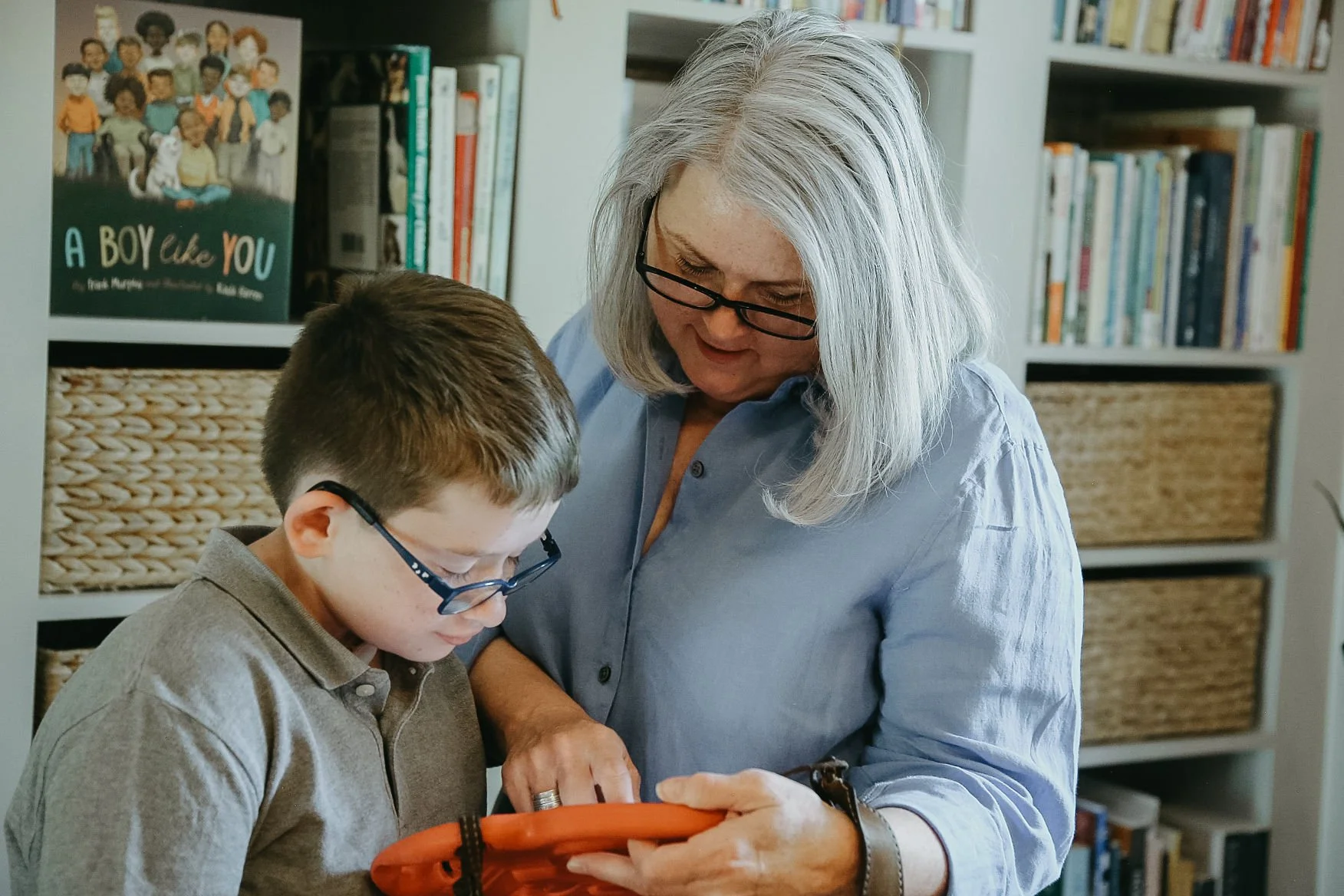
Communication is belonging.
Every post I write on communication ultimately exists to encourage and deepen relationships.
When we learned our son would never voice due to his airway anatomy, our explorations naturally led to Augmentative and Alternative Communication (AAC), access to systems and tools, language modeling, core vocabulary, parent coaching, communication within health systems, and the importance of autonomy.
In our parent led approach to intervention, communication has not been something we waited for, it is something we provided access to.
Communication transforms families. Communication changes education.
For our non-speaking son, AAC was not seen as a replacement for a lacking ability, but it was the path to revealing ability.
I believe language acquisition through AAC is successful when centered in relationships, immersion, and participation in everyday life.
Read more about communication in our home with a child dependent on AAC.
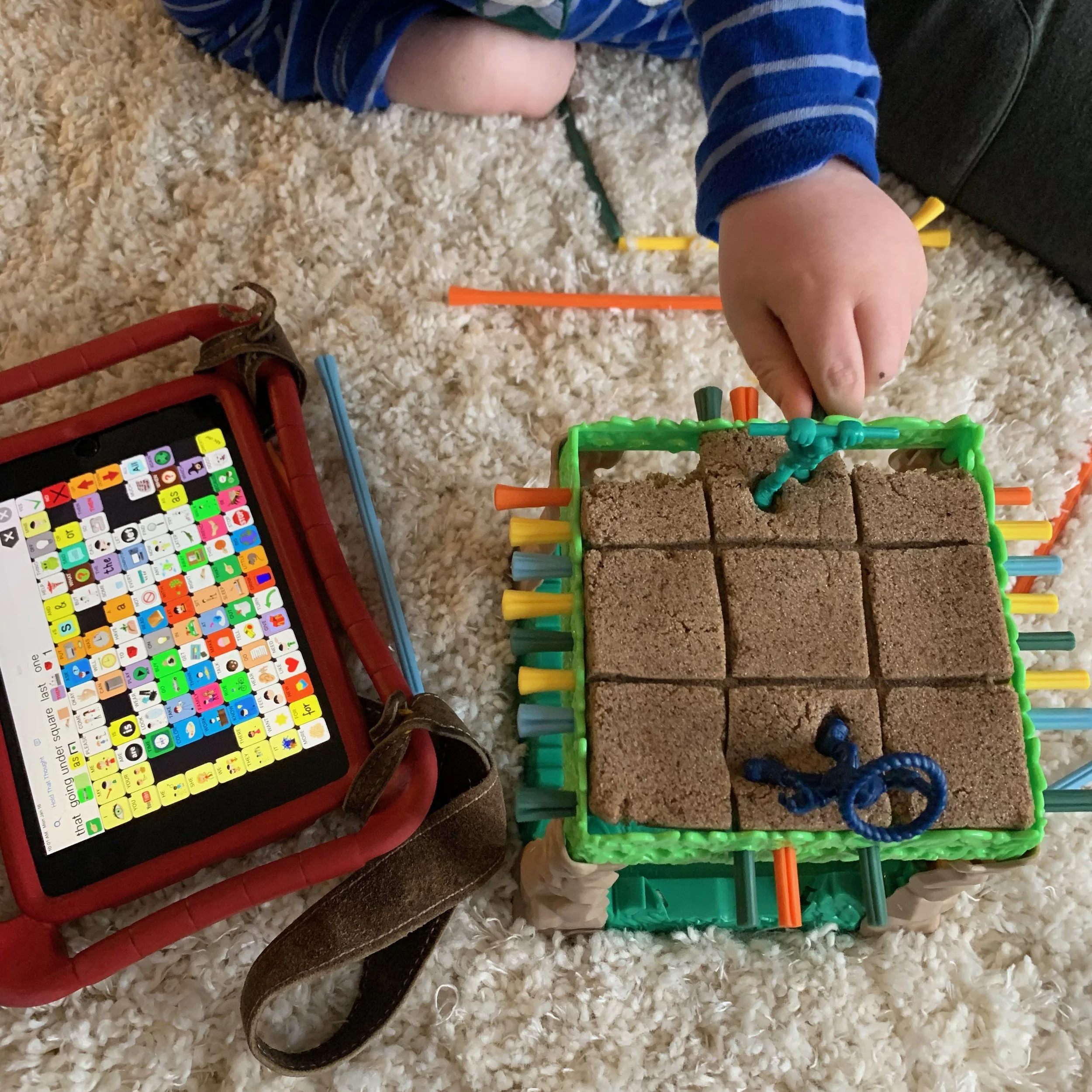
This week the augmentative alternative communication (AAC) activities in our homeschool focused on the words DAY, SORRY, TOGETHER, JOB. I selected these from the PrAACtical AAC August core words list one. This was a bit harder set of words for Nathaniel and I. All were on a second screen of his app, Speak for Yourself. I was still needing to use the app's search feature to find the words on Wednesday. Thank goodness we only have to navigate two screens to find each word.
We are like every other AAC family.
Despite all the blog posts I've written this month about providing an AAC immersion educational setting for kindergarten at home for our son, we struggle daily. Sometimes we go long stretches of the day without modeling language on Nathaniel's device. There are times we have to search for the device to advert a communication frustration meltdown. Sometimes we leave the device in the car. Under the bed. In the other room. Sometimes we are too tired, too hurried, to doubtful that this will really work.
Like other AAC families, we need constant encouragement to keep on keeping on.
We need simple ideas of incorporating language into our lives that require little set up, little clean up, and no expense.
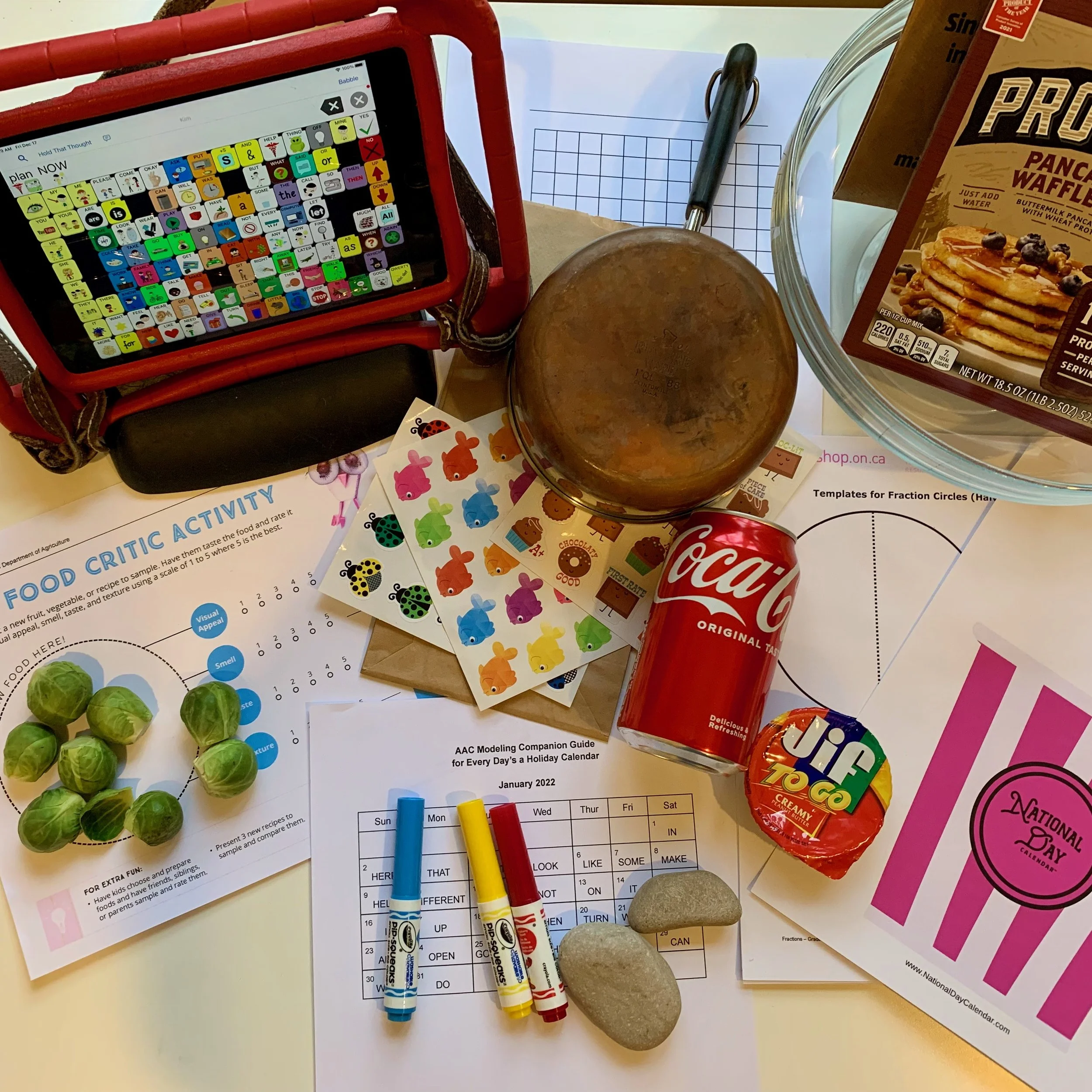
This week the augmentative alternative communication (AAC) activities in our homeschool focused on the words SAME, READY, IS, WITH. I selected these from the PrACCtical AAC's list of core words for July. My goal is do one fifteen to twenty minute activity per day that allows me to model the words and motivate Nathaniel to use his device and learn new language skills. I am currently trying to model three to five word utterances. In my examples below, I model all the words except those in parentheses. I have put this week's core words in all capitals to draw attention to them. Simpler modeling option would be to only model the targeted core word.
This week, our augmentative alternative communication (AAC) activities focused on the words THEY, BEFORE, LATER, MUCH. I selected these from the PrACCtical AAC's list of core words for July. My goal is do one fifteen to twenty minute activity per day that allows me to model the words and motivate Nathaniel to use his device and learn new language skills. I am currently trying to model three to five word utterances.
I just completed the first week of my twenty-five year homeschooling. That is a sentence I didn't expect to ever write. Our seventh child, Josiah, graduated high school in the spring of 2016, and I anticipated for over a decade that his graduation would end my homeschool teaching. Decisions about our son Nathaniel's education have been a long (mostly kept private) wrestle over the last few years. Perhaps in time I will share more about the small decisions that landed us at last Monday - Nathaniel's first day of Kindergarten in our homeschool. But for today, I just want to share about that first week.
We are using PrACCtical AAC's list of core words for our July augmentative and alternative communication work with Nathaniel. My goal is do one fifteen to twenty minute activity per day that allows me to model the words and motivate Nathaniel to use his device and learn new language skills. There are twelve words in the list; that is a lot to take on all at once. I've found success with focusing on four words per week for three weeks and then having the last week of the month to mix it all up and revisit some of our favorite activities. The words we are worked on this week were FIND, COLOR, AND, and LOVE. Nathaniel loves to speak in one word utterances and let his communication partner do the work, but he more than capable of two to three word utterances; longer utterances are emerging. I tend to model between three and five word phrases and sentences. He is becoming aware of pronoun use, present progressive verb endings, and adding a plural s.
I know it has been a long time since I posted on the blog when I can not remember my log in password. I have many topics for blog posts floating around in my head; I haven't made writing a priority this last month.
I am going to ease back into blogging. Nathaniel and I participated in a week long challenge to share photos that represent the hash tag #seemeseemyaac. The goal of the Facebook campaign was to bring awareness of alternative and augmented communication. People participated from all over the world. Pretty cool. Here are our photos and the snippets of information I shared with each photo about our AAC efforts.
I am learning a multitude of ways not to teach and help Nathaniel. I wrote a lengthy blog post in September about starting to memorize bible verses with him. Seven months later, I have learned that approach did not work. Or perhaps it is better stated that in recent months my goals have changed, and so my approach needs to change too. If this topic is new to you, click on the link above to learn where we started.
I made a new AAC friend last month. Dr. Carole Zangari, who blogs at PrACCtical AAC, and I spent a few hours on the phone getting to know each other and discussing her recently published book, Tell Me AAC in the Preschool Classroom. I have been desperate for direction for Nathaniel's education, and the program developed by Dr. Zangari and Lori Wise seemed promising. I have been studying the material daily since that conversation, and recently watched her webinar given through Saltillo. Dr. Zangari and I had a second phone meeting yesterday morning. At one point in our hour and a half conversation, I had to get up from the table and pace the living room floor; the excitement brewing inside needed a physical release.
I shared on my personal Facebook wall that we received our first rejection notice from a private Christian school for Nathaniel’s enrollment next fall. Someone commented, “I get how the school could make that determination. If they don't have a special education program with self-contained classrooms, then Nathaniel would have to be placed in a regular classroom. His medical needs and communication would most likely create classroom management issues.” The school’s reason "Our methodologies do not allow for a child to have a disability in the area of communication,” was the first hard blow of the day. The comment was a second and harder blow.
I knew as I walked out of the Pediatric Intensive Care Unit in November that Nathaniel would recover from the acute illness requiring swift intervention. His body was already responding to the IV fluids. However, I also knew that my heart will never recover. There is no ointment or medicine or surgery that can fix how it breaks when I have to pin Nathaniel’s little body to an emergency room gurney and hear him plead with his voiceless screams and beg with his searching eyes for the procedures to stop.
Original Post: October 2014. Updated: October 2015, October 2016
I think a lot about how to help Nathaniel understand and engage with the world and how to help the world understand Nathaniel. In this light, Halloween has been troubling me.
How does a child who can not speak and does not eat participate in Halloween?
We could skip it. There are many Christian homeschool families who avoid the holiday all together. We did at one point in our child rearing. In recent years Halloween has provided an excuse to spend time with our friends, Dan and Kelly and their seven children. October 31, 2013, Nathaniel's first Halloween, was a cold and rainy week night. After enjoying soup with our friends, we brought him home and missed the door to door part of the evening. In 2014, we celebrated Halloween with Nathaniel's foster family. We visited a few homes and went home early again.
In the middle of setting up our camping trip on Saturday, I received an email that rocked our world - Nathaniel's communication app was released for iPhone and we were invited to be beta testers.
In the time it takes to brown hamburger and open cans of beans to make chili, the app downloaded and I synced Nathaniel's vocabulary from a recent Dropbox backup. On the next trip carrying things outside, I sat down next to Nathaniel on the retaining wall from where he was watching his brothers cut wood. I handed him my phone with Speak for Yourself open. Inquisitively, he grabbed it, stared at the home screen for a minute, and then said "CHAINSAW."
My granddaughter can roll over. She did it the first time when her Nana, my son-in-law's mother, was taking care of her. My daughter called me to share the information excitedly later that day, "Blaise can roll over! Well... nobody actually saw her do it, but Jan laid her down on her back and went to heat her bottle, and Blaise was on her stomach when Jan came back."
I am jealous. Not because the other grandmother witnessed this milestone. Rather, my emotion stems from the contrast I sense in adults' reactions to Blaise and Nathaniel learning new skills. It only took one time of rolling over for all the adults in Blaise's life, me included, to consider the skill achieved. Blaise CAN roll over. There is an unspoken assumption there - she did it once and we fully expect she will keep doing it. She CAN roll over. It means thinking twice about leaving her on the couch or bed. It means keep dangerous things further away. Once was all it took.
For the last three months, Nathaniel has benefited from a very brief time of rote drill or recitation with me every morning. Using his talker, we count to ten, say the ABC's, and practice questions and appropriate responses. For example, I will ask, "What is your name?" to which he selects the one button on his device to respond, "My name is Nathaniel." Drawing on this skill yesterday when we were at a Labor Day picnic, he introduced himself to new friends. Within the last month he has shared his name with strangers at a playground. I do not believe these small social steps would be taking place if we were not working daily to recite.
Just as young children frequently memorize nursery rhythms and songs through repetition, the preschool years are often the time when children raised in Christian homes begin to learn their first Bible verses. Spiritual growth is as important to us as Nathaniel's emotional, physical, cognitive, and social growth. For generations of Rankins, the tool to encourage spiritual growth has been memorizing Bible verses. As a child and young adult, my husband memorized Bible verses weekly using Bible Memory Association, now called Scripture Memory Fellowship. Our children memorized Bible verses weekly through participating in the AWANA program. When they were small, we memorized the Sermon on the Mount as a family. We used motions, not American Sign Language, but our own creative fine and gross motor movements to help with the memorizing. The children were three years old to eleven years old when we recited the chapters of Matthew as a family standing in front of our church congregation. I have sweet memories not only of their incredible ability to learn and share long passages of scripture, but of working together daily after breakfast on the verses. The discipline of daily scripture memorization was formative to the children's minds and characters; the words they memorized had value to their souls.
We meet with our AAC team Wednesday afternoon for one of our quarterly consultations. It will be a transitional meeting for Nathaniel as his weekly speech therapist is anticipating a new baby soon. Nathaniel and Miss Rebecca had their last "before baby comes" session yesterday. (Many blessings to you and your little one, Rebecca!) Our therapy plans for the fall include continuing in Development Language Group two mornings a week and private therapy (Occupational and Speech) one morning a week.
As I prepare for our AAC meeting, I am again shuffling papers, making lists, and thinking about goals I have for Nathaniel's language growth. I reflect on times Nathaniel experiences communication frustrated as that often indicates areas that need solutions and work. This document, Language Functions & Early Generative Language Production by Gail M. Van Tatenhove, PA, MS, CCC-SLP, was given to me very early on in Nathaniel's AAC journey. It continues to be a help when I prepare for our AAC meetings. I revisited Tatenhove's word lists and compared the list to open words on Nathaniel's device. I have created a list of words that I feel we need to work on learning.
I shared earlier this week how I print low tech version of Nathaniel's talker symbols. (Read here.) Just as a reminder, Nathaniel uses Speak for Yourself. The symbol set is called Smarty Symbols and I use Custom Boards to create printables. Most of the time, that has worked flawlessly for me. Occasionally, I can not find the correct symbol on Custom Boards. I have asked some questions behind the scenes of both SFY and Smarty Symbols folks and learned that yes, some symbols used when SFY was originally developed are not currently available. I use the following options when I am unable to find the SFY symbol on Custom Boards.
Vani, a speech therapist from Australia, emailed to ask how I print high quality low tech versions of Nathaniel's talker symbols. Hope this helps explain how I create and use them. Bonus! A free printable of some Speak for Yourself transportation symbols that fit in the Cariboo game, is included at the bottom.
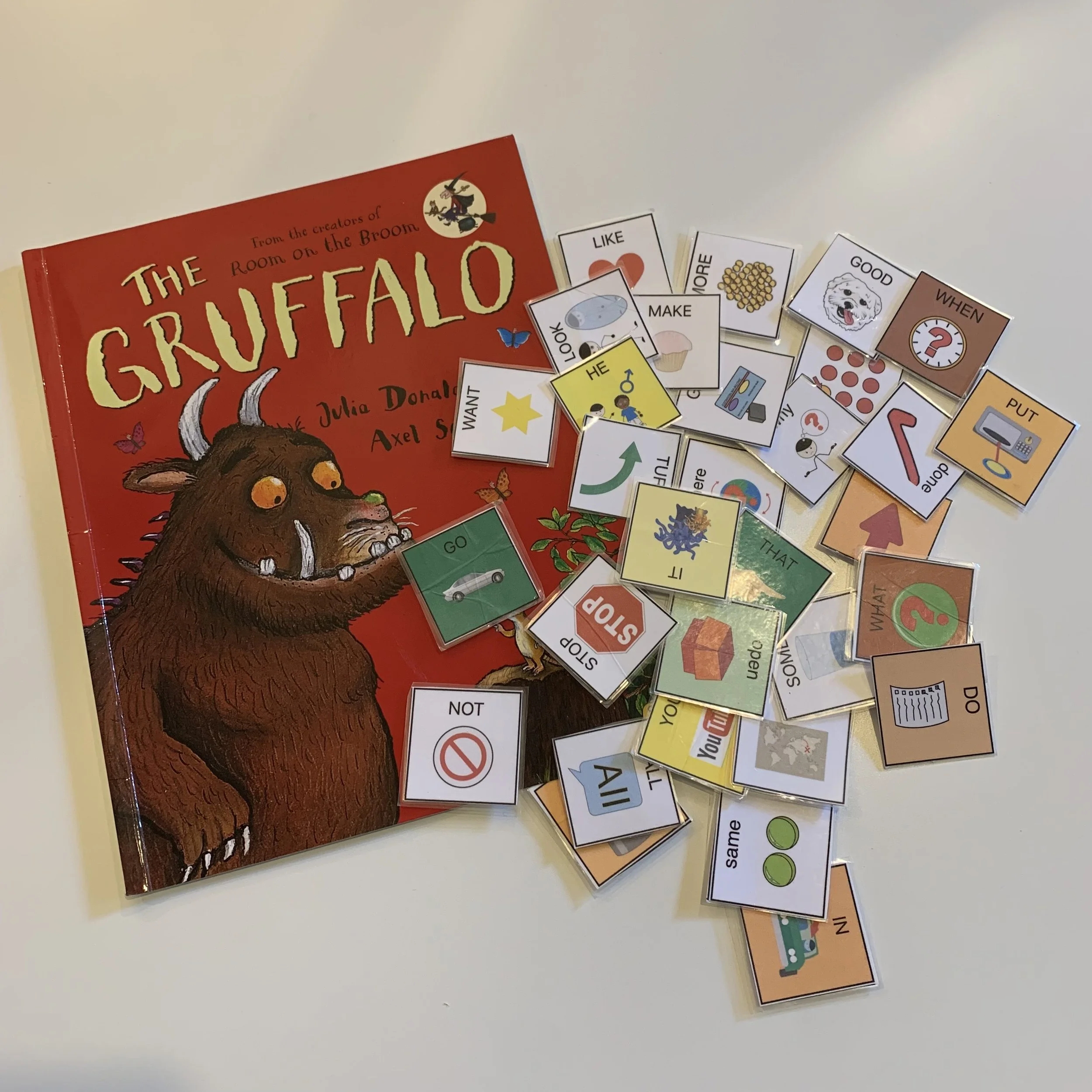
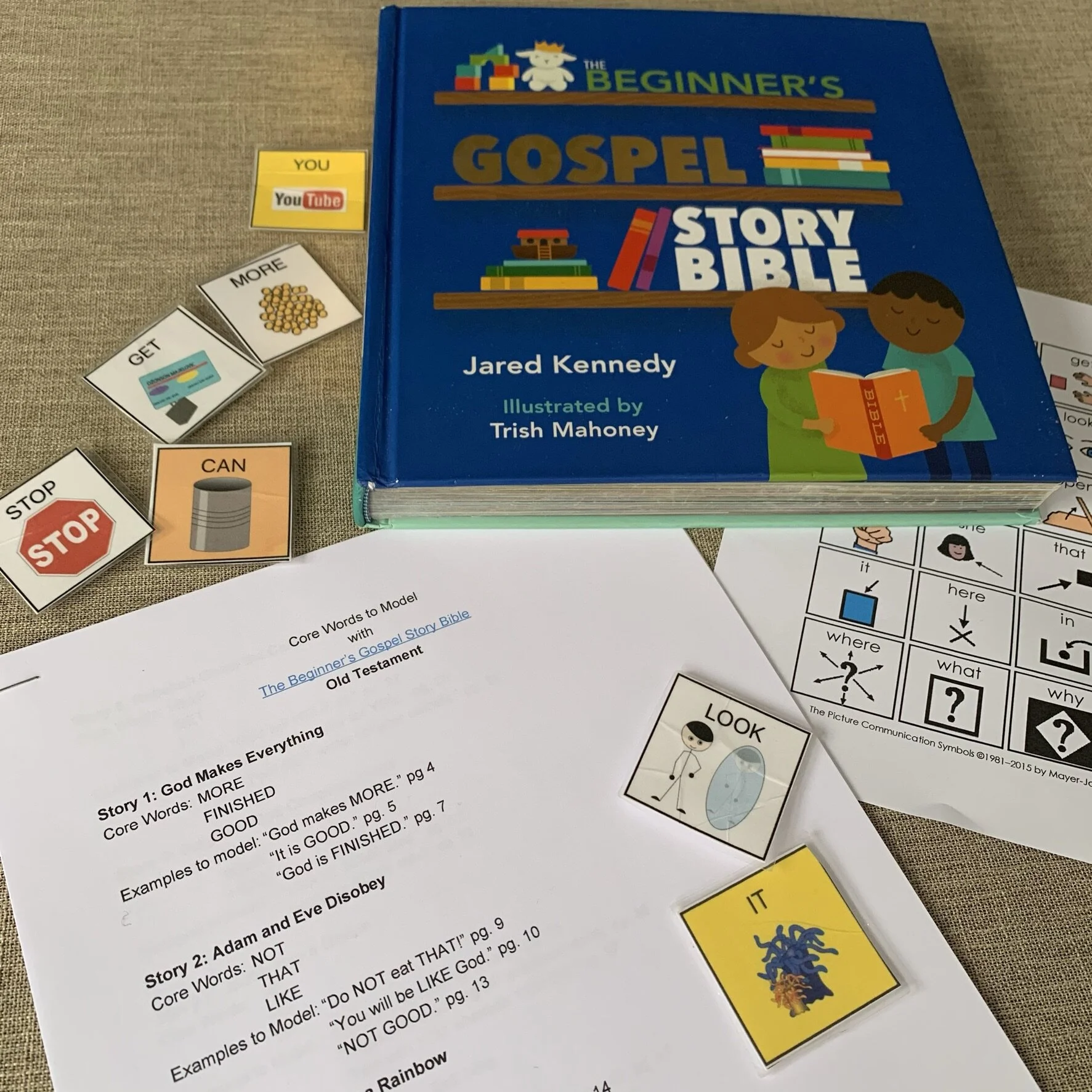
Nathaniel uses the app Speak For Yourself (SFY). The symbol set for Speak for Yourself is Smarty Symbols. We use low tech versions of these symbols to drill our five weekly words, to offer a visual of word combinations, and for Nathaniel's visual schedules. The photo below shows a variety of these uses. This week's words on the the left, the other photos show some visual schedules.
It was during the second session of developmental language group that I realized another layer of complexity because of Nathaniel's inability to produce any audible noise with this vocal cords.
He can not scream to protect himself from others or get help.
When Nathaniel was fourteen months old, our then speech therapist asked if he was pointing at things. She expressed the importance of pointing and joint attention in language development and stressed that these were precursors for further language growth. She advised that I should place Nathaniel, who was still new at sitting up, in the middle of the room with everything desirable out of reach. "Unless Nathaniel points to the object, do not let him have it. No toys until he points to them."
Nathaniel was perfectly content to sit quietly for full days without toys.
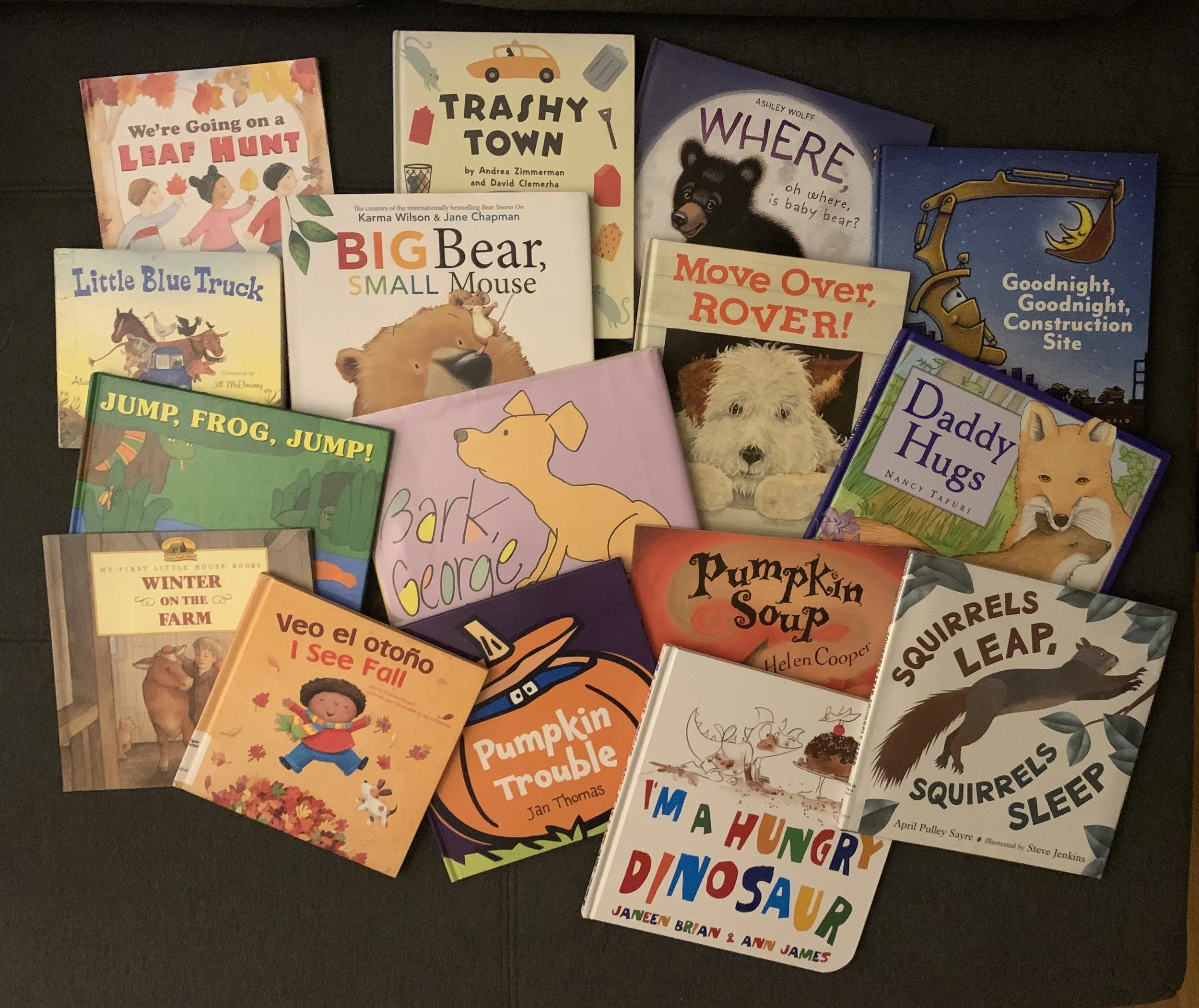
At our last augmented communication team session, one of the therapists asked me how Nathaniel does with books. "Oh," I thought to myself, "we're doing great here. They will be so impressed!" Out loud I said, "Really well! We read ten to fifteen books a day. We get books from the library. We have set times through out the day when we read. And we use the talker while reading too!" They asked for further explanation on my last point.
I have read to Nathaniel since his first day home. Shared moments of reading between parent and child is foundational to my understanding of child rearing. My mother read to me. My Aunt Beccy kept stacks of books in her car for her children and other young riders. My mother's cousin was an elementary school teacher and gave me most of her classroom library when she retired. I was nineteen. I had children's books before I had children. Through our years of homeschooling, reading books aloud has been a pivotal aspect of our curriculum and our family's day.
Rich and I are professionals at a consistent bedtime routine. I think we crave it as much as the children. It closes our day familiar and predictable. We share responsibilities; we know our roles. Nathaniel knows the schedule too. After bath and g-button care, trach ties, lotion, and pajamas, he is ready for stories. Then a short cuddle on a parent's lap in the rocking chair, and he crawls willingly into bed. Many nights, Rich shares these last moments of the day with Nathaniel, while I use the time to catch up on emails, prepare for the next day, or write. Last night, Nathaniel came into the living room between stories and getting in bed. Something new. He was carrying his talker. He said, "Night Night, Mommy," and offered a hug.
It has been about six months since I offered a review of Nathaniel communication growth and shared what we are working on. Nathaniel's new bedtime routine reminded me that I have much to write about.
Last May our daughter suggested that I put together an list or index for blog posts about Nathaniel. When she tells people that she has seven brothers, that the youngest is three years old and the oldest is thirty-three years old, she gets a lot of questions. She likes to send the curious to my blog for information about Nathaniel.
"But where should they start to read, Mom? And how do they find specific posts?"
I have been working on this list since that conversation. The process of compiling and specifically having it completed today, the second anniversary of Nathaniel's adoption, has been a special gift to myself. It was good to reflect on where we have been, what life has been like for Nathaniel and our family, and how God has been faithful through it all. After spending hours rereading these old posts I must add my AMEN to Jason Johnson's words tucked in a recent blog post, "foster care and adoption are not just the process by which we may change a child’s life but also the means through which God will radically transform ours."
We are having fun with a snow today! We had a little dusting about a week ago, but today was our first playable snow. This homeschool mom does not allow snow days. I save them up for spring fever days - those first days of spring that are so beautiful one can not possibly stay indoors and do school. So after my normal morning meeting with Josiah, Nathaniel and I headed outdoors.
Nathaniel first insisted on exploring the snow mittenless. That, and our entire outdoor experience, last less than two minutes. That smile faded quickly into many tears. We found a different pair of mittens that he seemed to like better than the first I tried, and went out again. The experience went much better the second time.
Yesterday I visited my own blog to find a link for someone and realized it has been two weeks since I posted last. It takes our family at least a week to recuperate after one of Nathaniel's hospitalizations. Thanksgiving, recuperating, and now preparing for Christmas have all tumbled into each other and filled the empty crevices in each day.
Rich took off a couple hours early one Friday evening so we could go cut down our Christmas tree. With two of our older boys working retail, finding times for this traditional family outing was tricky. We can't remember the year we started going to this tree lot, but we think it has been around twenty-years. It is one of my favorite Christmas moments.
PrAACtical AAC, a popular blog for speech therapists working in augmented communication, shared a post this morning that hit me hard. "No matter what the age or type of disability," it said, "almost all AAC learners face the challenge of communicating effectively during encounters with healthcare professionals. People with AAC needs are among those who are considered to be communication vulnerable and do best when there are planned supports in place."
Communication vulnerable.
Last week, my father asked me how I know if Nathaniel wants to add a new word to his talker. Isn't that just like a grandparent - challenging the middle generation on behalf of the younger - I love it!
Thankfully, I had a recent example of Nathaniel and I negotiating the addition of a new word to share with him. Nathaniel became infatuated with the movie Frozen this month. Despite our encouragement that he let it go, he hasn't. His usual show requests are Curious George, Daniel Tiger, or Cars Movie - all titles he has on his talker. Rather than using his talker to request his normal shows, he repeatedly brought me the DVD case for Frozen.
I have had two busy weeks since I returned from Wyoming. Three priorities have been filling my days: Josiah's homeschool work, Nathaniel's speech program, and getting ready to leave again. I will dedicate an entire blog post to our homeschool year someday, and I will write a bit below about new developments in augmented communication. But first some details about my next trip.
Nathaniel and I are leaving Sunday for Cincinnati again. We will be there two weeks this time. On Monday he will have a FEES study to evaluate his aspiration. On Tuesday he will have a tonsillectomy and adenoidectomy. Hopefully he will spend just one night in the hospital for observation, but we will need to stay in a hotel the Cincinnati area until October 3rd to be near the surgical team through a post-surgery risk period.
AAC
View the entire AAC archive here.
Language Development
A few weeks ago, my nieces visited our home for their annual week of "Camp Rankin." We meet their family at the same park, halfway between our homes, each year to pick up and drop off the girls. Visiting a playground only once a year provides amazing insight into the changes in Nathaniel's physical abilities. In 2015, he kept his feet on solid ground. Walking on the uneven park surface carrying his tube feed in a backpack was challenging enough. In 2016, he was comfortable walking up a ramp to the lowest play area. His aunt and cousin were watchful spotters to his emerging climbing skills in 2017. This year it was hard for any of us to keep up.
Nathaniel pinched play dough bits off the ball I held out to him. He poked each piece into the Fun Factory press. Diligently and silently, he worked at the task. Once the press was full, he pushed down on the lever. He watched the play dough ooze through the three holes moving blue snakes across the table. For the twenty minutes that he worked, I modeled language on his communication device.
Two years ago today we gave Nathaniel an iPad mini with an augmented communication app. He was twenty months old. There was much we did not know at the time. We knew very little about augmented communication or Nathaniel's long term communication needs. We did not know about key guards or child friendly cases or stands or modular tubing to hold the device at an easy access point. In some ways this might have worked in our benefit. In all our not knowing, we did not know how unusual it was to give a twenty-month old a high-tech, voice output device. We wanted to give our son access to words. Lots of words. All the words he would need to be fully twenty months old
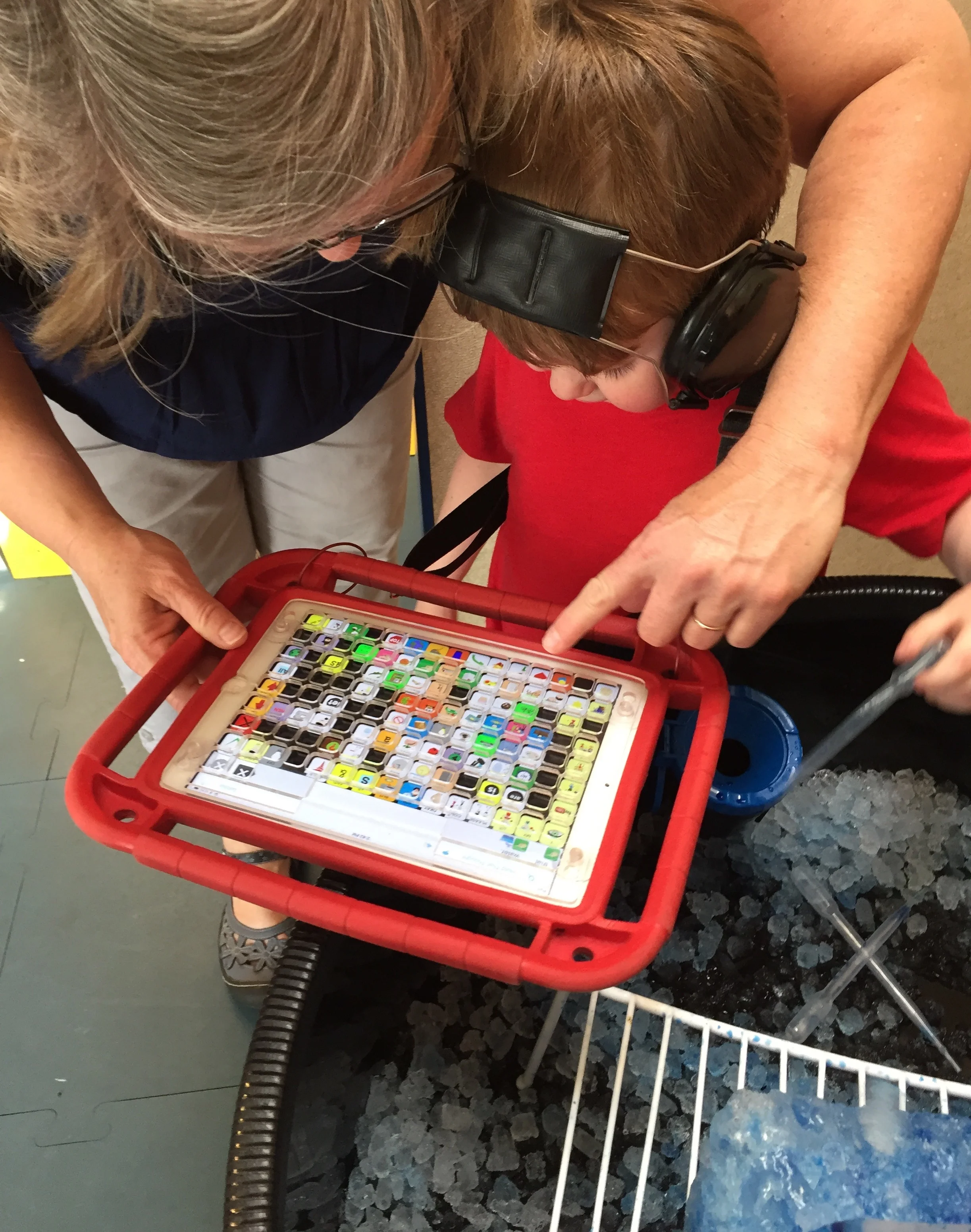
I realized something new in our quarterly AAC consultation earlier this month. We were discussing Nathaniel's ownership of his device and the need for him to have it with him at all times. I've been honest with the team and on my blog that I struggle with this idea. He is three, little for his size, and his device is a full size iPad. It is cumbersome even in the lightest case. I know he needs his words available. I dislike putting the responsibility on him to carry them or wear them at all times.
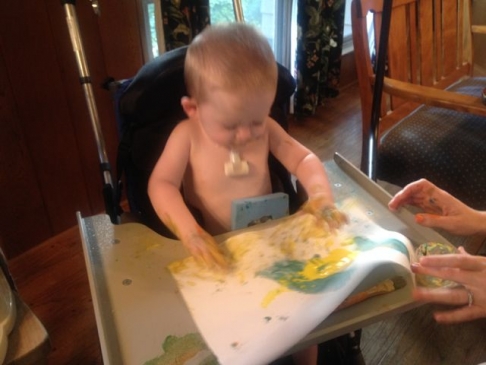
I brought up messy play. "Nathaniel shouldn't have to give up messy play because he is wearing his words..." I said. We use our water table daily three seasons of the year. On warm summer days, it is my son's "afternoon at the pool" experience. His words and device are exchanged for water, sand, shaving cream, cooked and dyed spaghetti noodles, mud, and rocks.
Nathaniel is taking a college class! Well, not really. Nathaniel is a college class. He has been accepted into a preschool level Developmental Language Group (DLG) at a local university. This summer he attends for two hours two mornings a week. The program is offered through a hands-on clinic where students enrolled in a Masters of Science in Speech-Language Pathology program work with patients under the supervision of university faculty members. For the summer session, three clinicians and an instructor are working with six children. Nathaniel is the only AAC user. He is learning to navigate play and preschool programing alongside peers capable of speaking.
POOP
PEE
POTTY
UH OH!
I NEED TO GO POTTY!
We started potty training a few weeks ago. Day one my focus was just on the task. Running to the potty, resetting the timer, running to the potty again fifteen minutes later. I signed TOILET to represent this process and I suspect this will be Nathaniel's first way to communicate the need. But I quickly realized we need potty language on the talker. Speak for Yourself (SFY), the speech generating app that Nathaniel uses, had TOILET pre-programmed. That will be helpful in years to come, so I made the word available. We may use it from time to time in modeling. But TOILET is not age appropriate language for all the stuff little ones learn about through potty training.
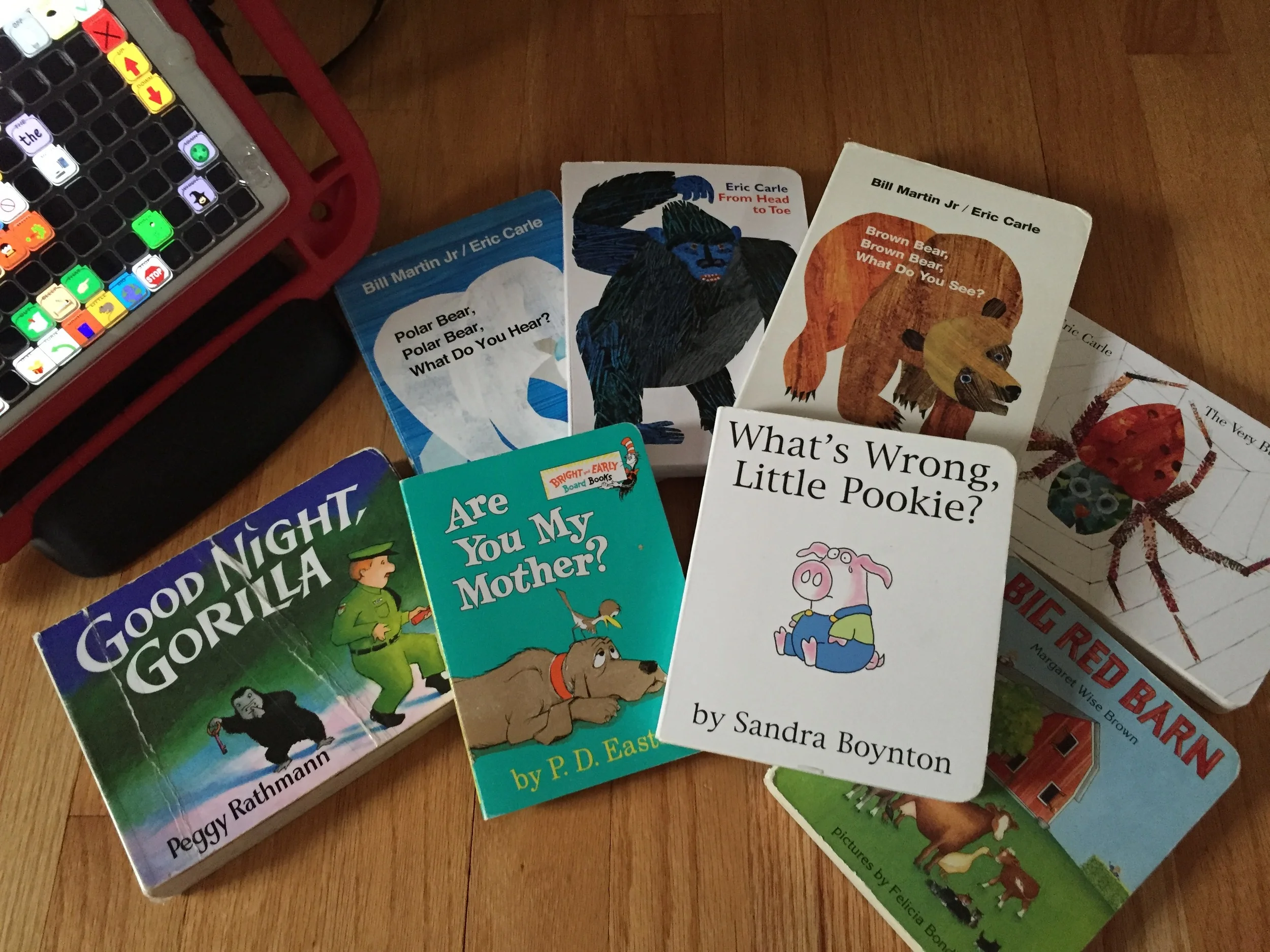
At our last augmented communication team session, one of the therapists asked me how Nathaniel does with books. "Oh," I thought to myself, "we're doing great here. They will be so impressed!" Out loud I said, "Really well! We read ten to fifteen books a day. We get books from the library. We have set times through out the day when we read. And we use the talker while reading too!" They asked for further explanation on my last point.
I have read to Nathaniel since his first day home. Shared moments of reading between parent and child is foundational to my understanding of child rearing. My mother read to me. My Aunt Beccy kept stacks of books in her car for her children and other young riders. My mother's cousin was an elementary school teacher and gave me most of her classroom library when she retired. I was nineteen. I had children's books before I had children. Through our years of homeschooling, reading books aloud has been a pivotal aspect of our curriculum and our family's day.

Last May our daughter suggested that I put together an list or index for blog posts about Nathaniel. When she tells people that she has seven brothers, that the youngest is three years old and the oldest is thirty-three years old, she gets a lot of questions. She likes to send the curious to my blog for information about Nathaniel.
"But where should they start to read, Mom? And how do they find specific posts?"
I have been working on this list since that conversation. The process of compiling and specifically having it completed today, the second anniversary of Nathaniel's adoption, has been a special gift to myself. It was good to reflect on where we have been, what life has been like for Nathaniel and our family, and how God has been faithful through it all. After spending hours rereading these old posts I must add my AMEN to Jason Johnson's words tucked in a recent blog post, "foster care and adoption are not just the process by which we may change a child’s life but also the means through which God will radically transform ours."
Three years ago tonight another woman held Nathaniel warm and secure in her body sheltered from the encroaching world. I don't know when her labor pains started or who drove her to the hospital. I don't know how many needle sticks it took to start her IV or what type of pain reliever she had. I do know that three years ago tomorrow morning, the doctors delivered a baby boy from her womb and she heard no cry.
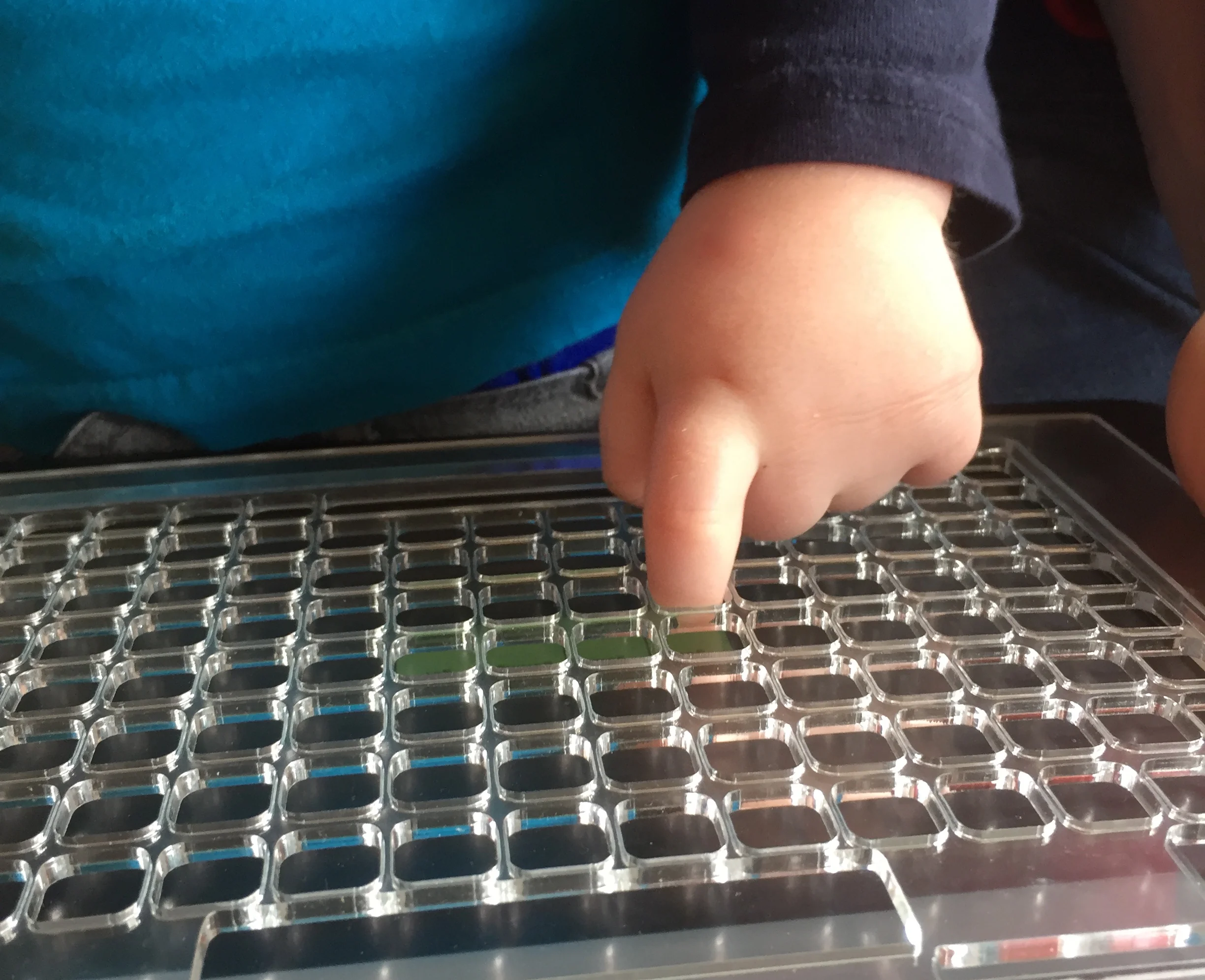
Last week, my father asked me how I know if Nathaniel wants to add a new word to his talker. Isn't that just like a grandparent - challenging the middle generation on behalf of the younger - I love it!
Thankfully, I had a recent example of Nathaniel and I negotiating the addition of a new word to share with him. Nathaniel became infatuated with the movie Frozen this month. Despite our encouragement that he let it go, he hasn't. His usual show requests are Curious George, Daniel Tiger, or Cars Movie - all titles he has on his talker. Rather than using his talker to request his normal shows, he repeatedly brought me the DVD case for Frozen.
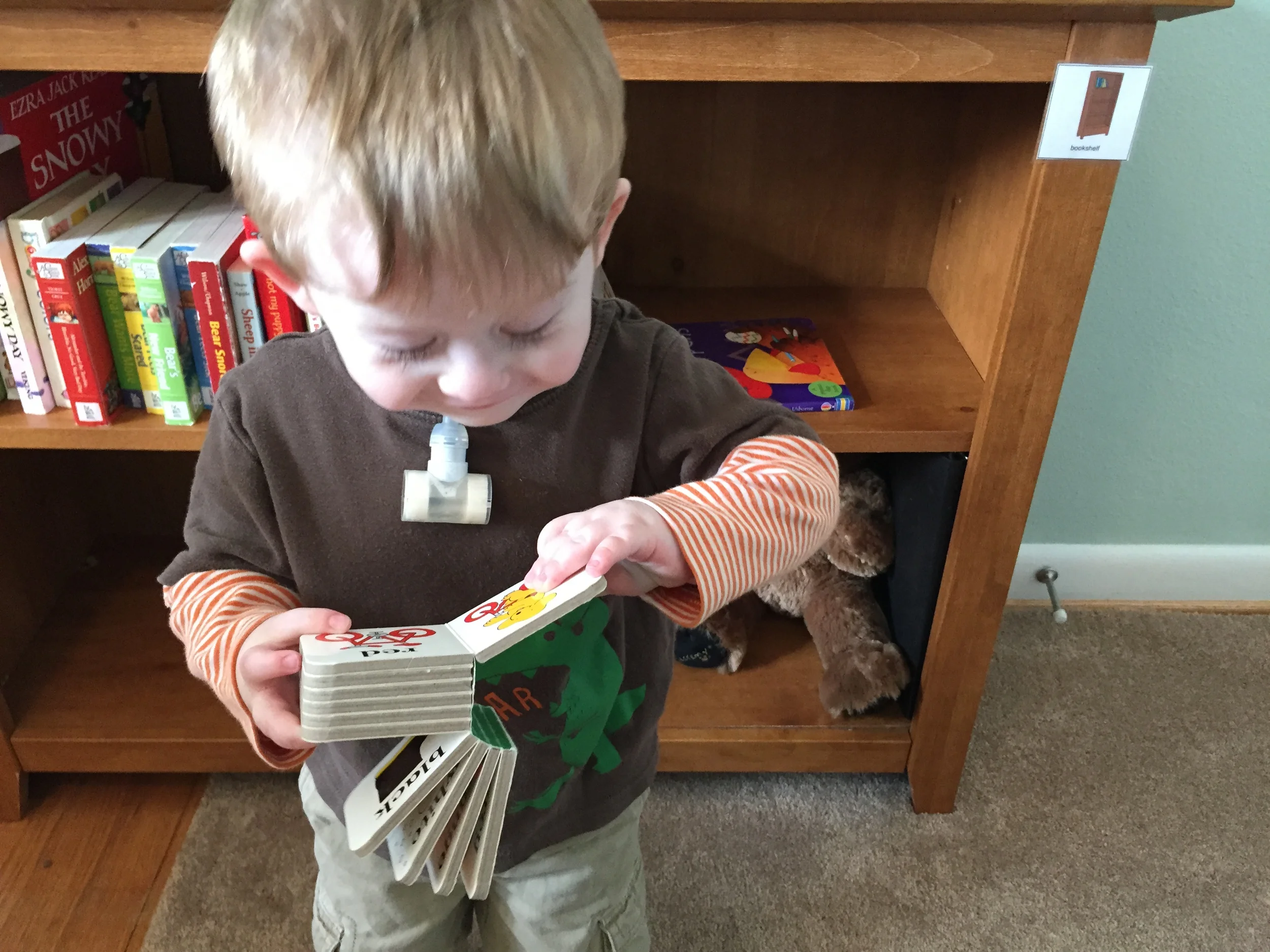
It has been awhile since I have compiled thoughts on Nathaniel's communication skills and use of augmented communication. We are headed to St. Louis Children's Hospital today to check in with the Aug-Comm team; I am excited to share Nathaniel's progress with them and thought I would use my preparation for the meeting to pull together a blog post on communication.
We spent last week with my extended family. My brothers and I are scattered around the United States now, but every year we meet in our home town, Lakeside, Ohio.
View the entire language archive here.

October is Augmentative Alternative (AAC) Awareness month. It is also the month annually that I have to resubscribe to the website building program I use to write and host this blog. The overlap strikes me as appropriate. My blog has slowly migrated into a site that focuses on Nathaniel and his need for communication; it is meaningful that I yearly recommit to sharing that journey during AAC awareness month.