

July Core Word Activities: Week 2
This week, our augmentative alternative communication (AAC) activities focused on the words THEY, BEFORE, LATER, MUCH. I selected these from the PrACCtical AAC's list of core words for July. My goal is do one fifteen to twenty minute activity per day that allows me to model the words and motivate Nathaniel to use his device and learn new language skills. I am currently trying to model three to five word utterances.

Stop Working So You Can Talk To Me: A Lesson For Mom On Modeling AAC
Nathaniel pinched play dough bits off the ball I held out to him. He poked each piece into the Fun Factory press. Diligently and silently, he worked at the task. Once the press was full, he pushed down on the lever. He watched the play dough ooze through the three holes moving blue snakes across the table. For the twenty minutes that he worked, I modeled language on his communication device.

When Medical Conditions Influence Educational Decisions
"Why don't you homeschool Nathaniel?" The question was the first thing my mom asked when I answered the phone early Tuesday morning. It was asked last Saturday by a college friend, who has close to thirty years experience in public school special education, after she read my blog post about a Christian school's denial to consider enrolling my son. It is a question Rich and I have repeatedly asked ourselves, and it is a logical one given that homeschooling has been our educational choice for our other children. Answering the question and making any educational decision on Nathaniel's behalf forces us to reflect on his journey.
When placed in our home through foster care, Nathaniel was enrolled in early intervention services offered through our state Department of Education. We have homeschooled for twenty-five years. Our experience with public education was limited to our older two sons who attended while living at their mother's home. Despite the unfamiliarity, we continued the services. The intervention model identified the child’s greatest need and offered one therapist to address concerns. Nathaniel was assigned an occupational therapist. We loved her. However, together we quickly realized that Nathaniel had more needs than she could meet in an hour a week. Speech and physical therapy were added. Nathaniel’s experience with early intervention speech therapy has been documented here. Not soon after we began sessions, we stopped them. We sought private speech therapy to tackle what we knew would be long-term communication needs.

How I Prepare for Our AAC Consultations
We meet with our AAC team Wednesday afternoon for one of our quarterly consultations. It will be a transitional meeting for Nathaniel as his weekly speech therapist is anticipating a new baby soon. Nathaniel and Miss Rebecca had their last "before baby comes" session yesterday. (Many blessings to you and your little one, Rebecca!) Our therapy plans for the fall include continuing in Development Language Group two mornings a week and private therapy (Occupational and Speech) one morning a week.
As I prepare for our AAC meeting, I am again shuffling papers, making lists, and thinking about goals I have for Nathaniel's language growth. I reflect on times Nathaniel experiences communication frustrated as that often indicates areas that need solutions and work. This document, Language Functions & Early Generative Language Production by Gail M. Van Tatenhove, PA, MS, CCC-SLP, was given to me very early on in Nathaniel's AAC journey. It continues to be a help when I prepare for our AAC meetings. I revisited Tatenhove's word lists and compared the list to open words on Nathaniel's device. I have created a list of words that I feel we need to work on learning.

Augmented Communication and Messy Play
I realized something new in our quarterly AAC consultation earlier this month. We were discussing Nathaniel's ownership of his device and the need for him to have it with him at all times. I've been honest with the team and on my blog that I struggle with this idea. He is three, little for his size, and his device is a full size iPad. It is cumbersome even in the lightest case. I know he needs his words available. I dislike putting the responsibility on him to carry them or wear them at all times.
I brought up messy play. "Nathaniel shouldn't have to give up messy play because he is wearing his words..." I said. We use our water table daily three seasons of the year. On warm summer days, it is my son's "afternoon at the pool" experience. His words and device are exchanged for water, sand, shaving cream, cooked and dyed spaghetti noodles, mud, and rocks.

AAC Part 7 - A New Turn in Our Journey
Nathaniel is taking a college class! Well, not really. Nathaniel is a college class. He has been accepted into a preschool level Developmental Language Group (DLG) at a local university. This summer he attends for two hours two mornings a week. The program is offered through a hands-on clinic where students enrolled in a Masters of Science in Speech-Language Pathology program work with patients under the supervision of university faculty members. For the summer session, three clinicians and an instructor are working with six children. Nathaniel is the only AAC user. He is learning to navigate play and preschool programing alongside peers capable of speaking.

Potty Talk and Augmented Communication
POOP
PEE
POTTY
UH OH!
I NEED TO GO POTTY!
We started potty training a few weeks ago. Day one my focus was just on the task. Running to the potty, resetting the timer, running to the potty again fifteen minutes later. I signed TOILET to represent this process and I suspect this will be Nathaniel's first way to communicate the need. But I quickly realized we need potty language on the talker. Speak for Yourself (SFY), the speech generating app that Nathaniel uses, had TOILET pre-programmed. That will be helpful in years to come, so I made the word available. We may use it from time to time in modeling. But TOILET is not age appropriate language for all the stuff little ones learn about through potty training.

Augmented Communication Part 7 - Combining Words, Current Goals, and Singing.
Rich and I are professionals at a consistent bedtime routine. I think we crave it as much as the children. It closes our day familiar and predictable. We share responsibilities; we know our roles. Nathaniel knows the schedule too. After bath and g-button care, trach ties, lotion, and pajamas, he is ready for stories. Then a short cuddle on a parent's lap in the rocking chair, and he crawls willingly into bed. Many nights, Rich shares these last moments of the day with Nathaniel, while I use the time to catch up on emails, prepare for the next day, or write. Last night, Nathaniel came into the living room between stories and getting in bed. Something new. He was carrying his talker. He said, "Night Night, Mommy," and offered a hug.
It has been about six months since I offered a review of Nathaniel communication growth and shared what we are working on. Nathaniel's new bedtime routine reminded me that I have much to write about.
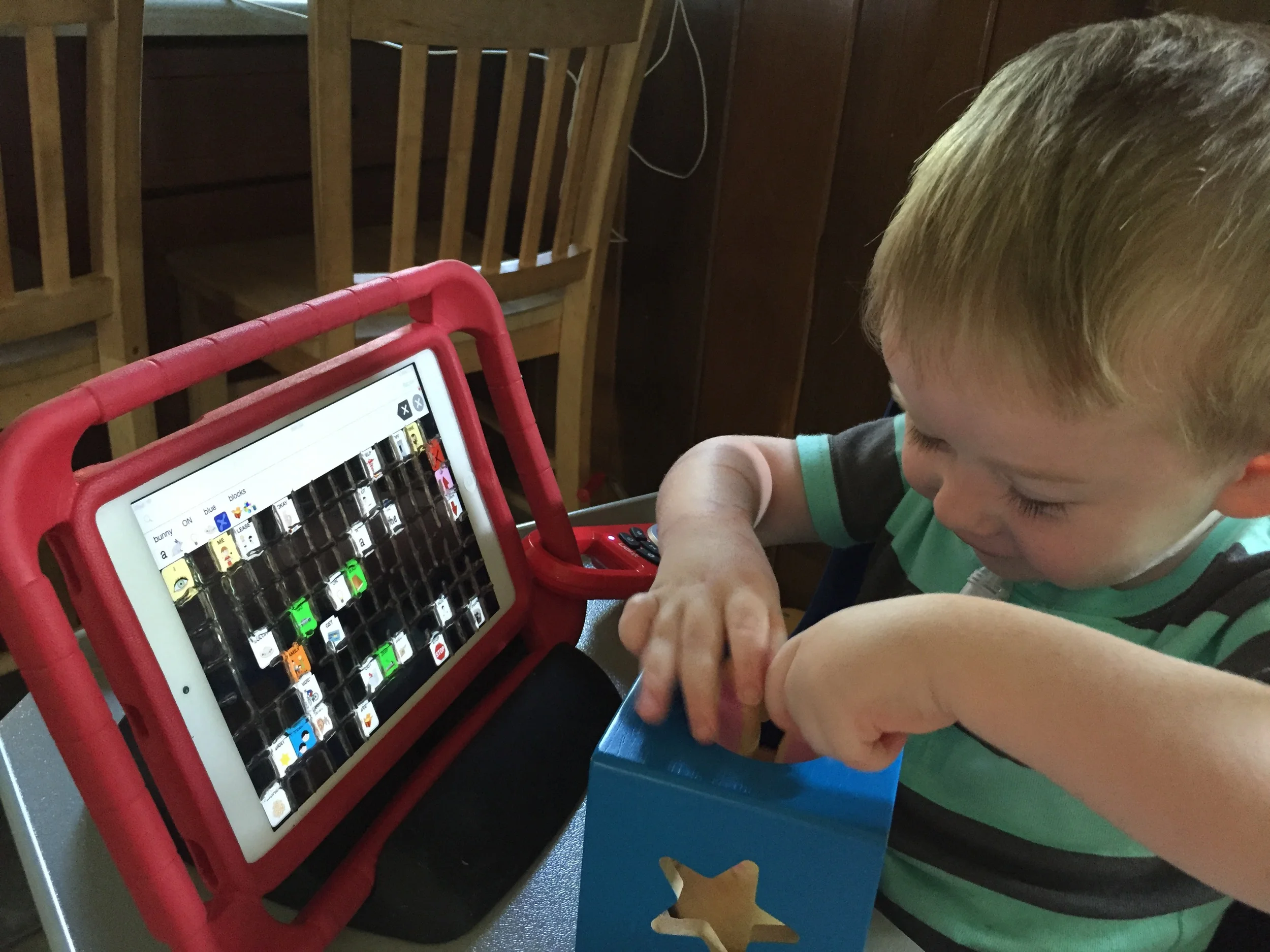
Augmented Communication - Part 5: MOMMY and 216 Other Words
Ben, Nathaniel and I went to Lowe's this week. Nathaniel had his talker in the cart and when the cashier started talking to him, I reached over and used the talker to say HI on his behalf. It is the easiest way to let someone know he is not going to respond verbally. Most often, hearing the talker catches people off guard and I can quickly sense the individual's familiarity and comfort with special needs children. The cashier came alive when she heard the device. She had questions. By the end of our transaction, she had shared that her own son has Down's Syndrome and was given a Speech Generating Device (SGD). He does not use it because he was teased and told it was for babies. She wanted more information. We wrote down the name of the app, name of my website, and the name of Nathaniel's new Facebook page.