
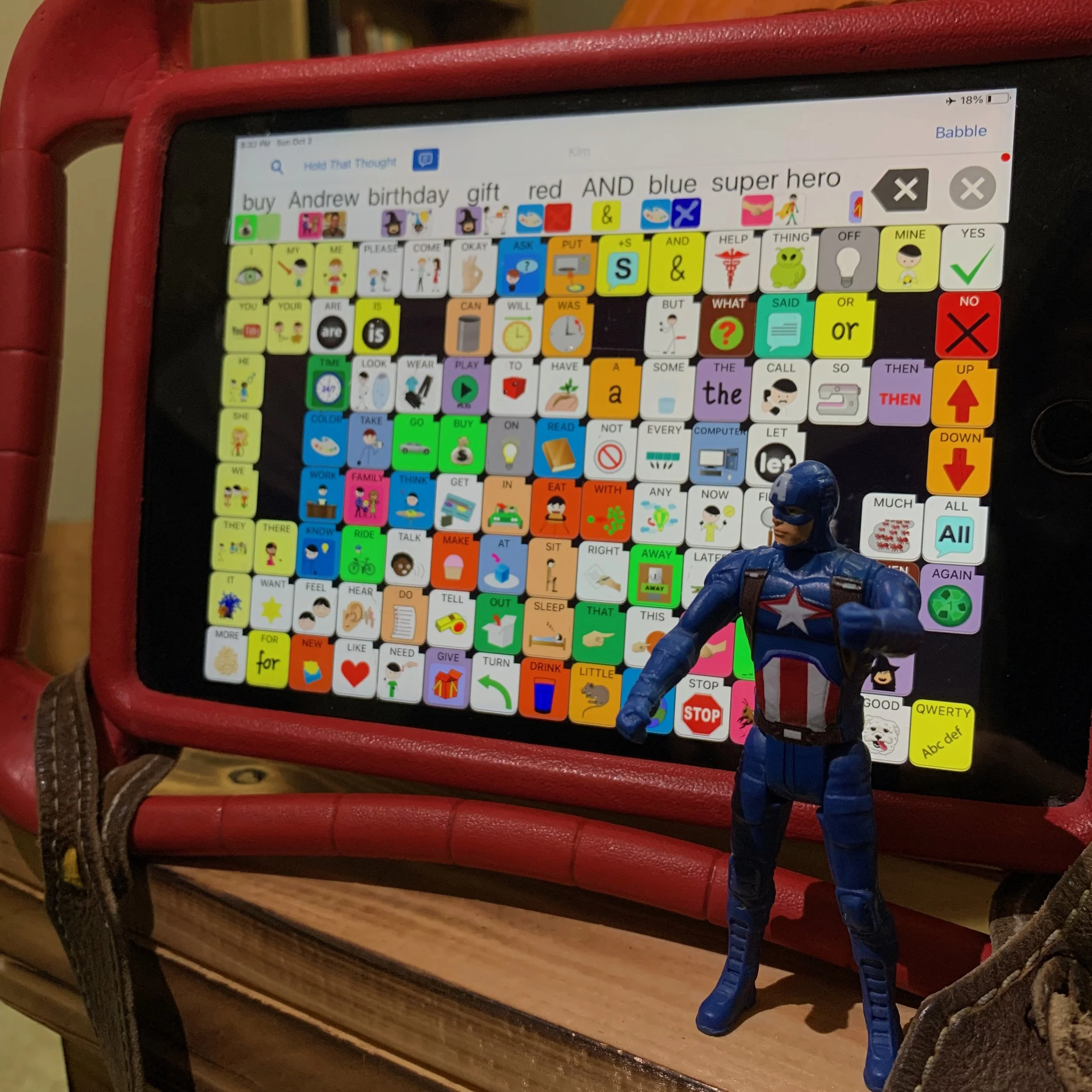

Some Big "Little" Exciting News - Speak for Yourself on iPhone
In the middle of setting up our camping trip on Saturday, I received an email that rocked our world - Nathaniel's communication app was released for iPhone and we were invited to be beta testers.
In the time it takes to brown hamburger and open cans of beans to make chili, the app downloaded and I synced Nathaniel's vocabulary from a recent Dropbox backup. On the next trip carrying things outside, I sat down next to Nathaniel on the retaining wall from where he was watching his brothers cut wood. I handed him my phone with Speak for Yourself open. Inquisitively, he grabbed it, stared at the home screen for a minute, and then said "CHAINSAW."

Augmented Alternative Communication and Bible Verse Memory
For the last three months, Nathaniel has benefited from a very brief time of rote drill or recitation with me every morning. Using his talker, we count to ten, say the ABC's, and practice questions and appropriate responses. For example, I will ask, "What is your name?" to which he selects the one button on his device to respond, "My name is Nathaniel." Drawing on this skill yesterday when we were at a Labor Day picnic, he introduced himself to new friends. Within the last month he has shared his name with strangers at a playground. I do not believe these small social steps would be taking place if we were not working daily to recite.
Just as young children frequently memorize nursery rhythms and songs through repetition, the preschool years are often the time when children raised in Christian homes begin to learn their first Bible verses. Spiritual growth is as important to us as Nathaniel's emotional, physical, cognitive, and social growth. For generations of Rankins, the tool to encourage spiritual growth has been memorizing Bible verses. As a child and young adult, my husband memorized Bible verses weekly using Bible Memory Association, now called Scripture Memory Fellowship. Our children memorized Bible verses weekly through participating in the AWANA program. When they were small, we memorized the Sermon on the Mount as a family. We used motions, not American Sign Language, but our own creative fine and gross motor movements to help with the memorizing. The children were three years old to eleven years old when we recited the chapters of Matthew as a family standing in front of our church congregation. I have sweet memories not only of their incredible ability to learn and share long passages of scripture, but of working together daily after breakfast on the verses. The discipline of daily scripture memorization was formative to the children's minds and characters; the words they memorized had value to their souls.

Printing and Using Low Tech Talker Symbols - Part 2
I shared earlier this week how I print low tech version of Nathaniel's talker symbols. (Read here.) Just as a reminder, Nathaniel uses Speak for Yourself. The symbol set is called Smarty Symbols and I use Custom Boards to create printables. Most of the time, that has worked flawlessly for me. Occasionally, I can not find the correct symbol on Custom Boards. I have asked some questions behind the scenes of both SFY and Smarty Symbols folks and learned that yes, some symbols used when SFY was originally developed are not currently available. I use the following options when I am unable to find the SFY symbol on Custom Boards.
Printing and Using Low Tech Versions of Talker Symbols
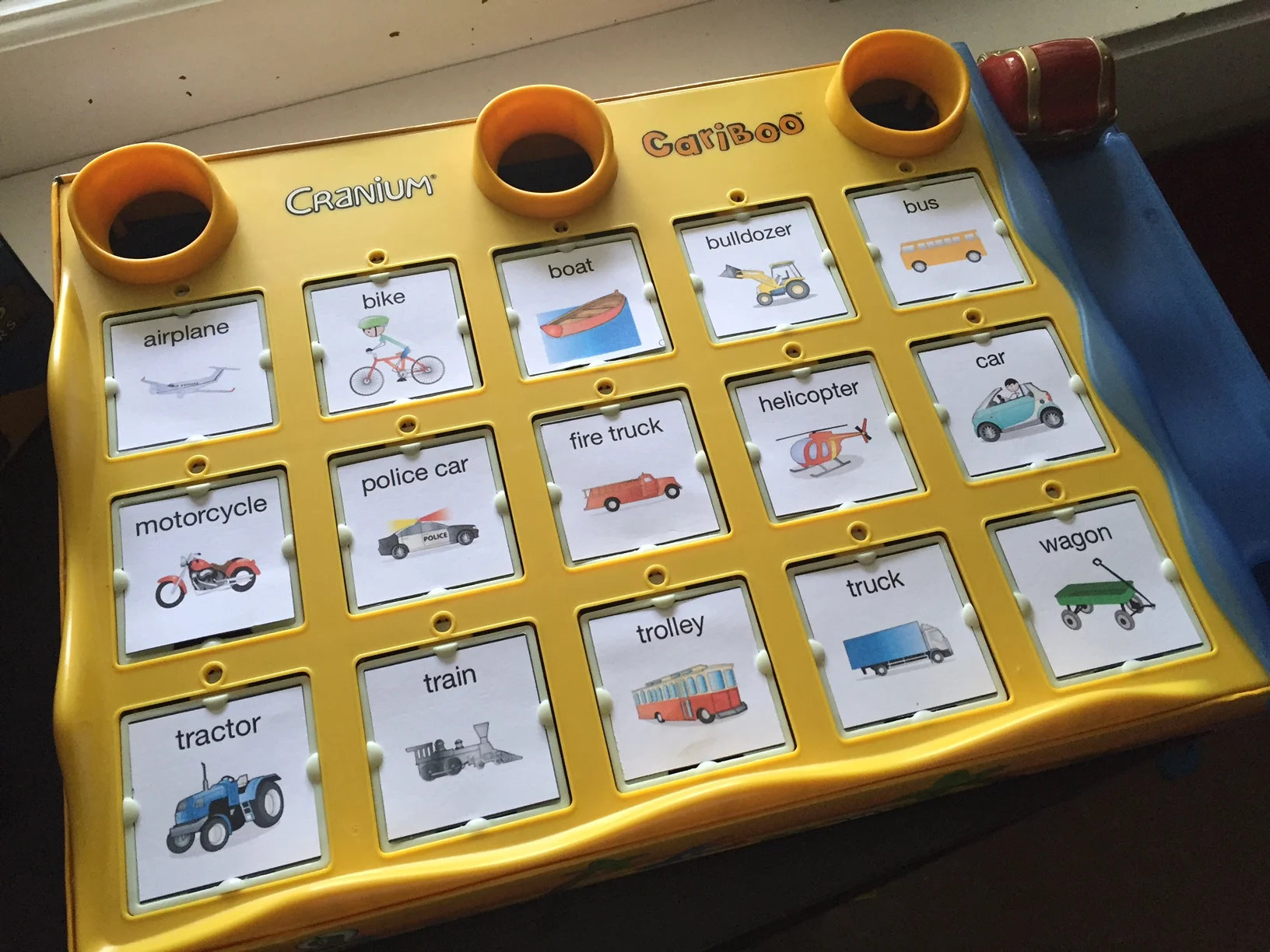
Vani, a speech therapist from Australia, emailed to ask how I print high quality low tech versions of Nathaniel's talker symbols. Hope this helps explain how I create and use them. Bonus! A free printable of some Speak for Yourself transportation symbols that fit in the Cariboo game, is included at the bottom.
Nathaniel uses the app Speak For Yourself (SFY). The symbol set for Speak for Yourself is Smarty Symbols. We use low tech versions of these symbols to drill our five weekly words, to offer a visual of word combinations, and for Nathaniel's visual schedules. The photo below shows a variety of these uses. This week's words on the the left, the other photos show some visual schedules.

Happy Second AAC Anniversary!
Two years ago today we gave Nathaniel an iPad mini with an augmented communication app. He was twenty months old. There was much we did not know at the time. We knew very little about augmented communication or Nathaniel's long term communication needs. We did not know about key guards or child friendly cases or stands or modular tubing to hold the device at an easy access point. In some ways this might have worked in our benefit. In all our not knowing, we did not know how unusual it was to give a twenty-month old a high-tech, voice output device. We wanted to give our son access to words. Lots of words. All the words he would need to be fully twenty months old

Potty Talk and Augmented Communication
POOP
PEE
POTTY
UH OH!
I NEED TO GO POTTY!
We started potty training a few weeks ago. Day one my focus was just on the task. Running to the potty, resetting the timer, running to the potty again fifteen minutes later. I signed TOILET to represent this process and I suspect this will be Nathaniel's first way to communicate the need. But I quickly realized we need potty language on the talker. Speak for Yourself (SFY), the speech generating app that Nathaniel uses, had TOILET pre-programmed. That will be helpful in years to come, so I made the word available. We may use it from time to time in modeling. But TOILET is not age appropriate language for all the stuff little ones learn about through potty training.

Augmented Communication Part 7 - Combining Words, Current Goals, and Singing.
Rich and I are professionals at a consistent bedtime routine. I think we crave it as much as the children. It closes our day familiar and predictable. We share responsibilities; we know our roles. Nathaniel knows the schedule too. After bath and g-button care, trach ties, lotion, and pajamas, he is ready for stories. Then a short cuddle on a parent's lap in the rocking chair, and he crawls willingly into bed. Many nights, Rich shares these last moments of the day with Nathaniel, while I use the time to catch up on emails, prepare for the next day, or write. Last night, Nathaniel came into the living room between stories and getting in bed. Something new. He was carrying his talker. He said, "Night Night, Mommy," and offered a hug.
It has been about six months since I offered a review of Nathaniel communication growth and shared what we are working on. Nathaniel's new bedtime routine reminded me that I have much to write about.
Augmented Communication Part 6 - More and More and More Words and a New Talker
Last week, my father asked me how I know if Nathaniel wants to add a new word to his talker. Isn't that just like a grandparent - challenging the middle generation on behalf of the younger - I love it!
Thankfully, I had a recent example of Nathaniel and I negotiating the addition of a new word to share with him. Nathaniel became infatuated with the movie Frozen this month. Despite our encouragement that he let it go, he hasn't. His usual show requests are Curious George, Daniel Tiger, or Cars Movie - all titles he has on his talker. Rather than using his talker to request his normal shows, he repeatedly brought me the DVD case for Frozen.